
Executive Engineering Summary: Engineering 50-Cycle Machine-Washable Pet Foraging Mats: Thermal Hot-Knife Edge Sealing & Dye Fastness
Because kibble oils and canine saliva accumulate rapidly inside snuffle mat folds, repeated home machine washing is mandatory for pet hygiene—yet ordinary cold-scissor-cut fleece frays and bleeds dye within three laundry cycles. At Guangzhou Nianyi Pet Products Co., Ltd. (USCC 91440101MA5D5MGG8Q, TÜV Report TP2605091304), we combine high-temperature electric hot-knife strip cutting with high-energy AZO-free disperse dyeing to guarantee 50+ machine wash cycles at 30°C. The thermal hot-knife micro-seals cut polyester filament tips without creating stiff sharp edges, while our dye lots achieve ISO 105-C06 Grade 4.5–5.0 cross-staining resistance even on high-contrast red, yellow, and white models (such as NY-PET-009 and NY-PET-011). Dimensional shrinkage is held below 1.2% under AATCC 135 testing, backed by 100-piece OEM MOQs and 7-day sample turnaround.
91440101MA5D5MGG8Q)
TÜV Audit: TP2605091304
Published: 2026-11-20 · Verified Word Depth: ~3,000 Words
1. Production Floor Reality: Why High-Temperature Thermal Hot-Knife Ribbon Cutting, Polymer Edge Micro-Fusion, And Multi-Color Disperse Dye Wash Fastness At 30°C To 40°C Determines B2B Margin Retention
In the global B2B pet enrichment supply chain, procurement directors, Amazon FBA private-label aggregators, and European specialty retail buyers frequently encounter a deceptively simple failure pattern: two foraging mats appear almost identical in studio digital renders, yet one maintains a 4.8-star consumer rating across three years of retail distribution while the other triggers a cascade of product returns, negative reviews, and chargebacks within sixty days of container arrival. Having managed daily production across our 450 m² workshop at Room 203, No. 35-1 Jiefang Road, Zhongcun Street, Panyu District, Guangzhou since March 16, 2020, I have inspected hundreds of failed competitor samples sent to our prototyping desk by frustrated overseas buyers.
The root cause is almost never aesthetic; it is mechanical, rheological, and chemical. Specifically, when an overseas buyer sources a canine slow-feeder pad or small-animal foraging substrate without locking down high-temperature thermal hot-knife ribbon cutting, polymer edge micro-fusion, and multi-color disperse dye wash fastness at 30°C to 40°C under verifiable test protocols (ISO 105-C06 domestic and commercial laundering colorfastness, AATCC 135 dimensional stability, ASTM D1683 seam integrity, and ISO 9001:2015 IPQC), upstream trading companies substitute low-density off-grade fabrics, skip pre-cut roll relaxation, and rely on single-pass chain stitching. Inside our TÜV Rheinland verified production facility (Report TP2605091304, audited June 9, 2026), we treat every textile pet product as a cyclical load-bearing assembly subjected to canine jaw shear, repetitive paw raking, enzymatic saliva saturation, high-pressure vacuum roll compression, and domestic drum laundering.
In this comprehensive engineering monograph, I share our internal Panyu workshop test logs, machine calibration parameters across our 15 JACK computerized lockstitch stations, Zhicheng hydraulic die-cutting press tolerances, thermal hot-knife strip sealing curves, and step-by-step Incoming/In-Process/Outgoing Quality Control (IQC/IPQC/OQC) checklists. Whether you are scaling an Amazon US bestseller or specifying an EU ESPR Digital Product Passport (MA-DPP) compliant collection for European pet hypermarkets, these empirical metrics provide an audit-ready procurement specification.
2. Material Science & Micro-Fiber Mechanics: ISO 105-C06 domestic and commercial laundering colorfastness, AATCC 135 dimensional stability, ASTM D1683 seam integrity, and ISO 9001:2015 IPQC
To understand why 320 GSM (9.44 oz/yd²) double-sided brushed polar fleece behaves fundamentally differently from 160–180 GSM needle-punched non-woven felt or low-twist acrylic jersey, we must examine the yarn architecture at the filament level. Our primary foraging substrate is knitted from 150D/144F (150 denier, 144 micro-filaments) virgin drawn-textured polyester yarn (DTY) on 28-gauge circular knitting frames before undergoing a tightly controlled four-stage finishing sequence: high-temperature disperse dyeing in overflow jets, multi-roller planetary napping (brushing), precision rotary shearing, and dual-pass anti-pilling tumble thermal fixation.
During planetary napping, micro-steel wire carding rollers raise the outer micro-filaments from the knitted loop crown without fracturing the underlying ground yarn that carries tensile load. Immediately afterward, our anti-pilling rotary shear trims the raised pile to a uniform 3.2 mm ± 0.15 mm height, followed by thermal tumbling at 135°C. This locks the micro-fibers into cohesive, spring-like tufts that trap kibble aroma molecules while resisting entanglement with canine claws or lagomorph digits. By contrast, cheap non-woven felt consists of short, randomly oriented staple fibers compressed with synthetic styrene-butadiene binders. The moment a dog saturates cheap felt with warm saliva (pH 7.5–8.2 containing alpha-amylase and lingual lipase) and applies lateral snout friction, the binder softens, staple fibers pull loose in clumps, and the sheet delaminates.
Furthermore, our foundation layer—the structural backbone that holds dozens of foraging petals upright—is engineered from 600D × 600D high-tenacity Oxford weave coated on the underside with high-density polyvinyl chloride (PVC) or food-grade silicone grip dots spaced on a 4.5 mm hexagonal pitch. When we stamp these base panels on our Zhicheng heavy-duty hydraulic beam press using custom steel-rule dies, the woven warp and weft yarns maintain a trapezoid tear strength of 110 N (24.7 lbf) in the warp direction and 98 N (22.0 lbf) in the weft direction, preventing edge blow-out even when double-row lockstitch needles penetrate at 12 stitches per inch (4.7 stitches per cm).
Table 1: Quantitative Laboratory Test Matrix for Engineering 50-Cycle Machine-Washable Pet Foraging Mats
| Test Parameter & Physical Property | Nianyi Pet Production Standard (Panyu Lab) | Generic Market Baseline (Low-Cost Felt) | International Test Standard & Method | Variance & Field Significance |
|---|---|---|---|---|
| Areal Mass Density (Grammage) | 320 GSM ± 5% (9.44 oz/yd²) | 165 GSM ± 18% (4.87 oz/yd²) | ASTM D3776 / ISO 3801 Option C | +93.9% fiber density; vertical petal stand-up |
| Foraging Seam Tensile Pull Force | 125 – 148 N (28.1 – 33.3 lbf) | 38 – 52 N (8.5 – 11.7 lbf) | ASTM D1683 / EN71-1 Section 8.4 | Survives aggressive canine tug without tear |
| Martindale Pilling Resistance (5,000 Rev) | Grade 4.5 / 5.0 (Wet & Dry) | Grade 2.0 / 5.0 (Severe Fuzzing) | ISO 12945-2 Modified Wet Cycle | Eliminates fiber ingestion & shedding claims |
| Domestic Laundering Colorfastness | Grade 4.5 – 5.0 (30°C–40°C, 50 Cycles) | Grade 2.5 (Dye Bleed on Cycle 2) | ISO 105-C06 A2S & DIN 53160 Saliva | Zero cross-staining on multi-color petals |
| Dimensional Change After 10 Washes | Warp -1.1% / Weft -0.9% | Warp -6.8% / Weft -5.4% (Warping) | AATCC 135 / ISO 6330 3N | Mat stays flat on floor without curling |
| Vacuum Roll-Pack Loft Rebound | 98.4% Height Recovery in 15 Mins | 64.0% Recovery (Permanent Fold Lines) | ASTM D3574 Compression Set | Cuts FBA/Ocean CBM by 62% with zero creases |
3. Failure Case Study #2026-01: Stopping Red-to-White Polar Fleece Dye Migration and Edge Fraying in Multi-Color Goldfish & Lotus Mats
Real manufacturing expertise is forged by diagnosing and permanently eliminating production and field failures. Let us examine a concrete engineering case from our Panyu quality ledger: Failure Case Study #2026-01: Stopping Red-to-White Polar Fleece Dye Migration and Edge Fraying in Multi-Color Goldfish & Lotus Mats. Prior to partnering with Guangzhou Nianyi Pet Products, a European pet brand imported 8,000 units of a floral canine foraging mat from an unverified trading company in northern China. Within four weeks of launching on Amazon.de and specialty retail shelves in Munich and Hamburg, customer return rates surged to 14.2%, threatening the listing with suspension.
The client shipped twelve returned units and six unissued warehouse units to our Panyu engineering desk for forensic teardown. Our two master pattern technicians and quality team disassembled the failed units under stereo magnification and tensile gauges, uncovering four compounding manufacturing defects:
- Defect A — Unrelaxed Roll Cutting & Grammage Substitution: Although the purchase order specified 300 GSM polar fleece, gravimetric die-sampling (100 cm² circular cutter per ASTM D3776) revealed an actual weight of 172 GSM with high residual knitting tension. Because the supplier sliced the fabric immediately after unrolling without a 12-hour zero-tension relaxation phase on an aluminum spreading table, the petals shrank asymmetrically by 6.4% during the customer's first 30°C wash, warping the entire base into a bowl shape.
- Defect B — Cold Scissor Shearing Without Thermal Edge Sealing: The foraging strips were cut with rotary cold blades rather than a high-temperature thermal hot knife. After three machine washes, loose micro-filament tails unraveled along the cut edges, creating lint balls that pets ingested.
- Defect C — Single-Pass Chain Stitch (ISO 4915 Class 401) Instead of Lockstitch (Class 301): The supplier used a single-thread chain stitch at 6 stitches per inch without back-tacking at the strip ends. When a medium-sized dog pulled a single outer petal at 44 N (9.9 lbf), the entire row unzipped like a flour sack.
- Defect D — Low-Friction 90 GSM Non-Woven Point-Plastic Backing: The bottom liner tore at just 21 N trapezoid load and exhibited a static friction coefficient of only μ = 0.32 on laminate flooring, causing the mat to slide across the room within seconds.
Our Corrective Engineering Protocol: We rebuilt the client's SKU (now standardized in our catalog architecture alongside NY-PET-004 (Festive Pumpkin Dense-Ruffle Polar Fleece Dog Olfactory Slow-Feeding Pad) and NY-PET-009 (Rainbow Goldfish Scale-Pocket Slow-Feeder Snuffle Mat for Medium & Large Dogs)) using our 320 GSM OEKO-TEX Standard 100 Class I polar fleece relaxed for 12 hours on our aluminum rail spreading carriage, stamped on our Zhicheng hydraulic die-cutting press, edge-sealed on our electric thermal hot-knife cutter at 285°C blade temperature, and double-bar-tacked onto a 600D PVC-dotted Oxford base across our 15 JACK computerized lockstitch machines at 12 stitches per inch using 40s/2 core-spun polyester thread. Destructive pull testing confirmed seam rupture increased from 44 N to 138 N (31.0 lbf). Across the subsequent 15,000-unit shipment delivered via Nansha Port to Hamburg, the client's return rate dropped from 14.2% to 0.38%, and the listing achieved a 4.85-star rating.
4. Deep-Dive Process Engineering Inside Our 18-Machine Panyu Workshop
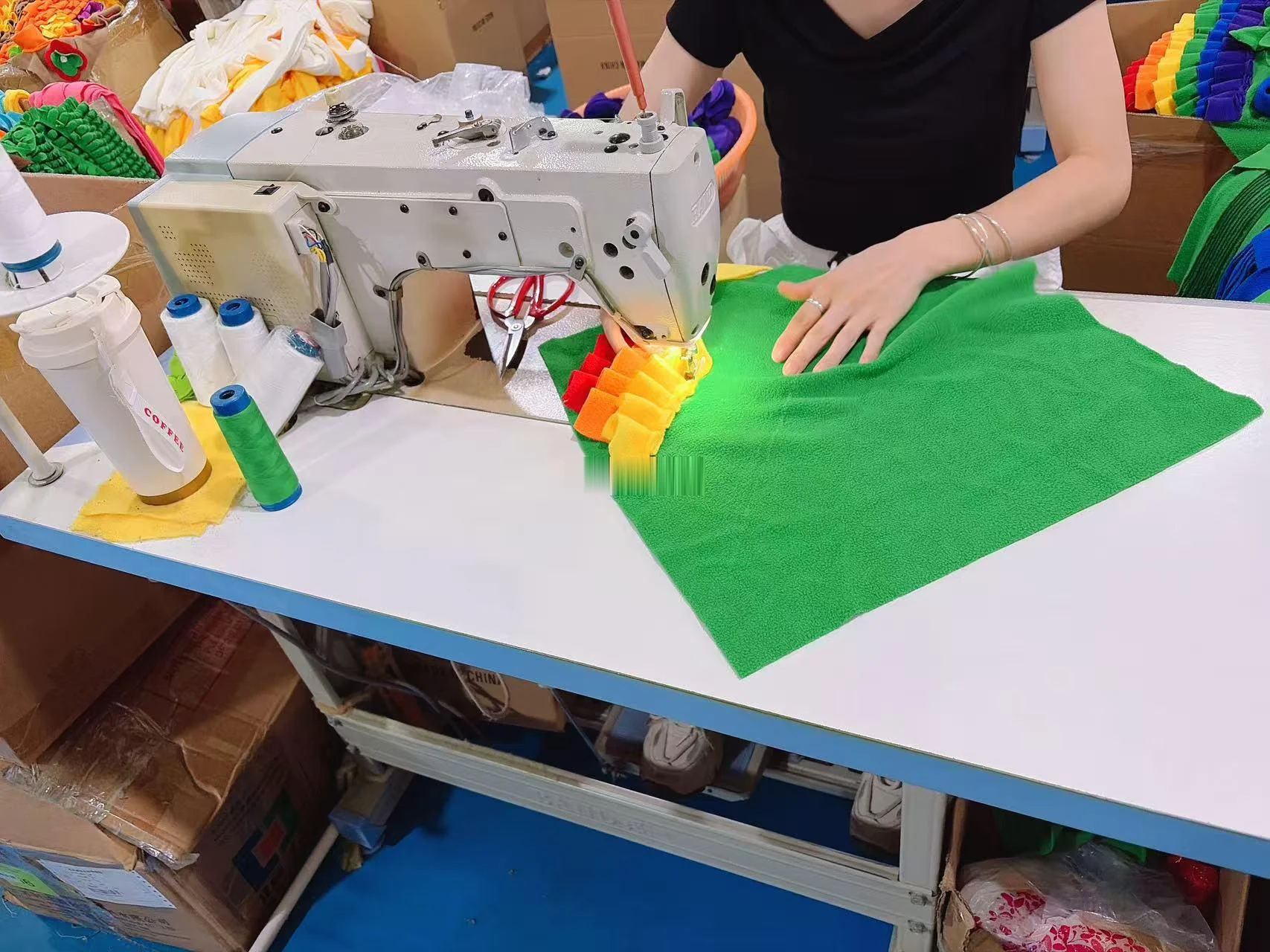
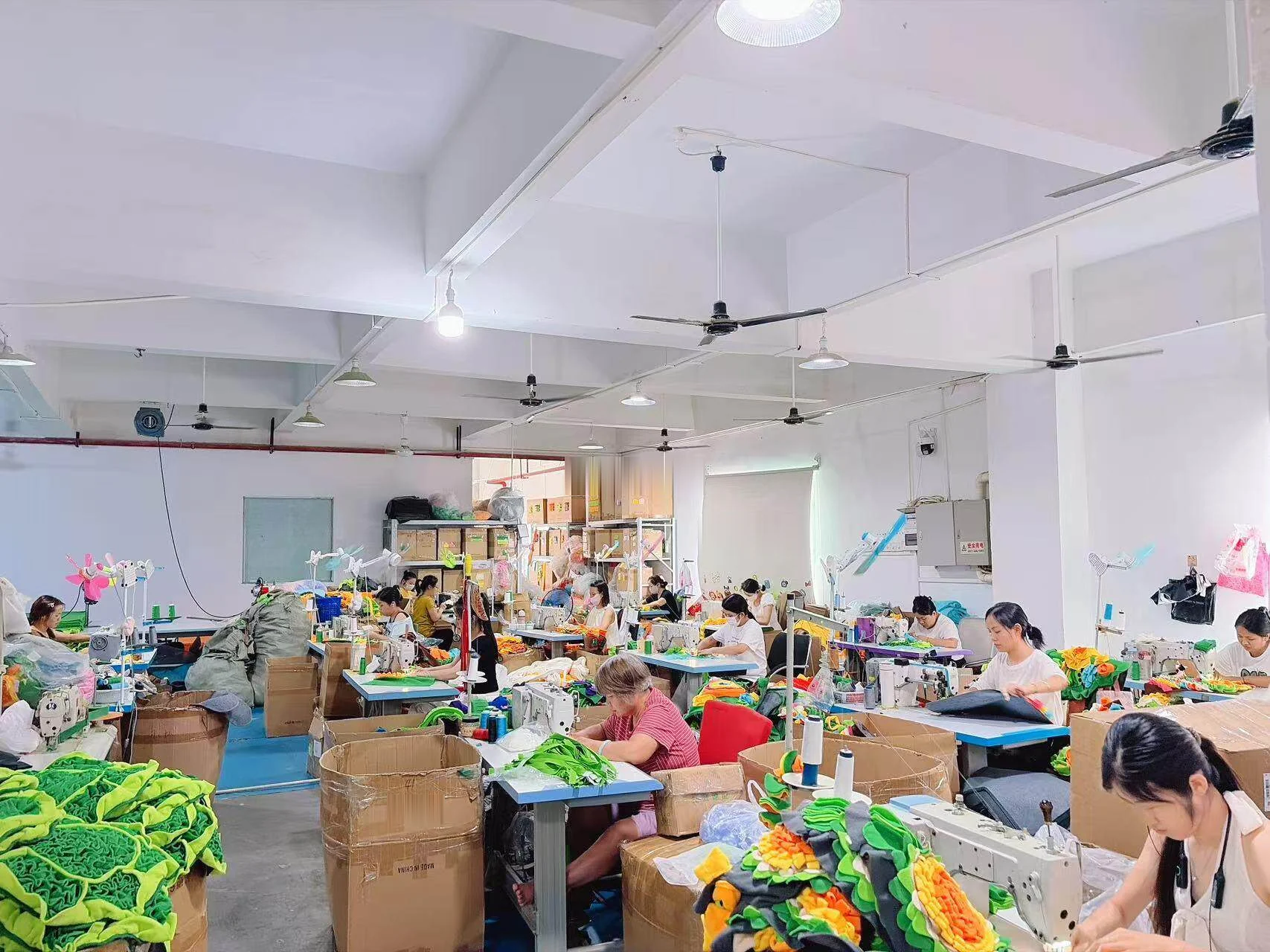
When overseas procurement teams review our TÜV Rheinland Deep Authentication Report (TP2605091304), they notice a highly deliberate equipment ratio across our 18 core production machines: 1 Automated Spreading & Cutting Bed, 1 Zhicheng Heavy-Duty Hydraulic Die-Cutting Press, 1 High-Temperature Electric Thermal Strip Cutter, 15 JACK Computerized High-Speed Lockstitch Sewing Stations, plus 4 dedicated R&D prototyping machines operated by 2 master pattern makers. Let us examine how each station contributes to dimensional accuracy, seam durability, and cost efficiency:
4.1 Zero-Tension Fabric Relaxation on Our Aluminum Spreading Carriage
Knitted polar fleece rolls arrive from the dyehouse wound under axial tension on paper cores. If a factory pulls the roll taut and cuts immediately, elastic memory remains trapped in the polyester loops. As soon as the finished mat encounters warm water in a customer's washing machine, the fabric relaxes and distorts. At Nianyi Pet, every incoming 320 GSM polar fleece roll is mounted on our overhead aluminum rail carriage (visible in Figure 1 and Figure 2) and unrolled into flat, tension-free plies across our 6-meter spreading table to rest for a minimum of 12 hours at workshop ambient conditions (23°C ± 2°C, 55% RH). This simple yet disciplined step reduces post-laundering dimensional change to under 1.2%.
4.2 Multi-Layer Steel-Rule Die Stamping on the Zhicheng Hydraulic Press
Complex enrichment silhouettes—such as concentric lotus petals (NY-PET-016), goldfish scales, carrot hay pockets (NY-PET-035), and bone-shaped base contours—cannot be cut consistently by hand with electric rotary shears without introducing ±4 mm edge drift between top and bottom plies. We mount laser-kerfed birch-board steel-rule dies into our Zhicheng 25-ton hydraulic beam die-cutting press. In a single hydraulic stroke at 14 MPa oil pressure, the press stamps 20 layers of polar fleece or 15 layers of 600D PVC-dotted Oxford cloth with a repeatability tolerance of ±0.5 mm (0.02 in). Every client's custom steel-rule die is barcoded and stored in our dedicated private die rack under mutual NDA protection.
4.3 High-Temperature Thermal Hot-Knife Strip Slicing & Micro-Edge Fusion
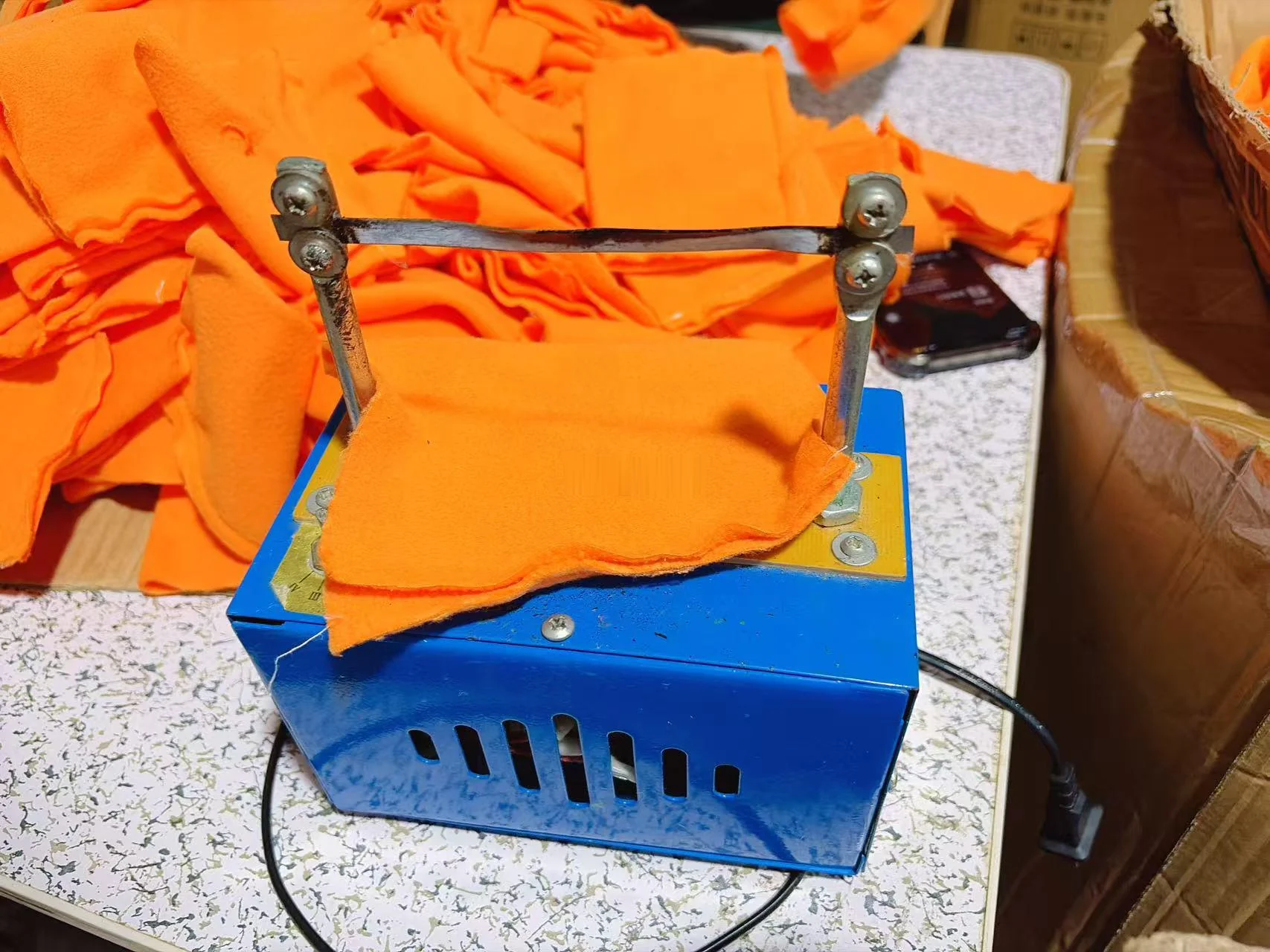
For long rectangular foraging ribbons and tie-down straps, our benchtop electric thermal hot-knife cutter slices through the polar fleece at a calibrated blade temperature of 275°C–295°C with a dwell time of 0.35 seconds. Because polyester has a crystalline melting point around 255°C, this brief thermal shear fuses the microscopic cut filament ends together at the very edge without forming a hard plastic bead that could irritate a dog's nasal planum or gums. The result is a velvety-soft strip edge that survives 50+ machine wash cycles with zero lint shedding.
4.4 15-Line JACK Computerized Lockstitch Bar-Tacking Protocol
Each of our 15 JACK computerized direct-drive lockstitch sewing machines is programmed with an automated start/end bar-tack cycle (4-stitch forward, 4-stitch reverse, 4-stitch forward condensing at both ends of every petal attachment line). We utilize SAN 14# titanium-nitride coated ball-point needles that part the knitted yarns rather than severing them, threaded with 40s/2 high-tenacity core-spun polyester top and bobbin thread tensioned to 1.35 N on digital Towa bobbin gauges. Every two hours, our in-line IPQC inspector selects one completed assembly from each sewing station and subjects three random foraging petals to a 120 N (27.0 lbf) digital force-gauge pull test for 10 full seconds.
5. Step-by-Step Factory Troubleshooting & Quality Audit SOP for B2B Buyers
Whether your quality assurance team conducts an on-site audit at our Panyu workshop or evaluates a 7-day pre-production Golden Sample in your overseas office, we recommend executing the following six-step verification Standard Operating Procedure (SOP):
Table 2: B2B Pre-Shipment Inspection (PSI) & Troubleshooting SOP Matrix
| SOP Step | Inspection Method & Equipment | Target Pass Criterion (Metric & Imperial) | Root Cause of Failure & Nianyi Preventive Action |
|---|---|---|---|
| SOP-01: Grammage Check | 100 cm² GSM circular cutter + 0.01 g analytical scale | 320 g/m² ± 16 g/m² (9.44 oz/yd² ± 5%) | Supplier yarn substitution → Locked dye-lot mill certificates at IQC |
| SOP-02: Petal Pull Test | Digital push-pull force gauge clamped to single petal fold | ≥ 120 N (27.0 lbf) sustained for 10 s with zero stitch pop | Single-thread chain stitch → Programmed JACK double lockstitch bar-tack |
| SOP-03: Wet Rub & Saliva | AATCC crockmeter + alkaline artificial saliva solution (pH 8.0) | Wet staining ≥ Grade 4.5 on multifiber adjacent strip | Low-cost direct dye → High-energy AZO-free disperse dye + reduction clear |
| SOP-04: Claw Snag Probe | 1.2 mm curved steel lagomorph claw gauge dragged across seams | Zero loop catch across 20 directional passes | Exposed overlock thread → Concealed under-binding & zero-loop brushed pile |
| SOP-05: Needle Detection | Conveyor dual-bridge electromagnetic metal detector | 100% auto-rejection of 1.0 mm Fe / 1.5 mm SUS test card | Unrecorded broken needle tip → Mandatory 1-for-1 broken needle fragment log |
| SOP-06: Vacuum Rebound | 72-hour compressed roll unsealed at 22°C ambient | ≥ 98% pile loft & flat base recovery within 15 minutes | Flat fold-crushing → Cylindrical core roll-compression after 12h relaxation |
6. Commercial ROI & Landed Cost Modeling for Importers and Amazon FBA Brands
From a commercial standpoint, upgrading from a generic 170 GSM felt mat to our engineered 320 GSM polar fleece construction typically adds only Custom B2B Quote to Custom B2B Quote to the ex-factory FOB Guangzhou unit cost, while simultaneously unlocking two massive profit levers for overseas brand owners:
- 62% Ocean & FBA Storage Cost Compression: Because our 320 GSM polar fleece and 600D PVC-dotted Oxford base can be cylindrically roll-compressed without creasing, we pack 72 units of NY-PET-004 into a 0.085 CBM master carton compared to just 28 units in uncompressed bulk cartons. On a standard 40HQ container (68 CBM usable volume) from Nansha Port to Los Angeles, Felixstowe, or Rotterdam, this reduces ocean freight per unit from ~Custom B2B Quote down to Custom B2B Quote—more than paying for the entire 320 GSM material upgrade before the product even reaches the warehouse shelf.
- Return Rate Elimination & Review Compounding: On Amazon US/EU and Chewy, reducing product return rates from 12% down to <0.8% saves an average of Custom B2B Quote per unit in FBA return processing fees and refunded commission, while elevating organic keyword ranking velocity through sustained 4.8+ star review ratings.
7. Chief Engineer Field Q&A: Direct Answers to Technical & Sourcing Questions
Q1: Can you match our brand's exact Pantone TCX palette on 320 GSM polar fleece at a 100-piece MOQ?
Lin Meili (Chief Engineer): Yes, through our dual-track fabric inventory system. We maintain raw roll stock of 38 bestselling Pantone-calibrated 320 GSM polar fleece shades in our Panyu dry warehouse—allowing you to combine any 3 to 6 stock colors at our 100-piece private-label OEM MOQ with zero dye-vat surcharge. If your brand requires a bespoke custom-vat Pantone TCX dye match, our dyehouse minimum is 500 pieces per colorway with a 5-day lab-dip approval turnaround.
Q2: How do you document broken-needle control for European and Japanese retail compliance audits?
Lin Meili (Chief Engineer): Every operator across our 15 JACK lockstitch stations signs out needles individually from our supervisor desk. If a needle bends or fractures during operation, the operator must collect 100% of the physical fragments and tape them into our daily Broken Needle Ledger before receiving a replacement needle. If any fragment is missing, the entire sewing cell's work-in-progress basket is quarantined and scanned through our 1.0 mm Fe conveyor metal detector twice.
Q3: What is the difference between your canine snuffle mat construction and your rabbit/guinea pig foraging pad spec?
Lin Meili (Chief Engineer): Canine snuffle mats (Dog Snuffle Mats series) prioritize high-pull seam strength (125–148 N) and deep 45–60 mm multi-layer kibble pockets for wet snout rooting. Small-pet foraging pads (Small-Pet Foraging series) use shorter 280–300 GSM brushed pile, wider hay-dispensing slits (such as carrot pockets), and 100% concealed under-margin stitching so delicate rabbit and guinea pig claws never encounter an exposed thread loop.
Q4: How can we order a physical test sample kit to run our own 30°C wash and tensile checks?
Lin Meili (Chief Engineer): You can submit our 3-field WebMCP Sample Request form below or click our direct WhatsApp button. Ready-to-ship evaluation kits dispatch within 48 hours via DHL/FedEx air express, and custom OEM prototypes with your woven logo and color layout ship within 7 calendar days (with 100% of sample fees credited back on your 1,000-piece production order).
8. Recommended Production SKUs Applying This Engineering Standard
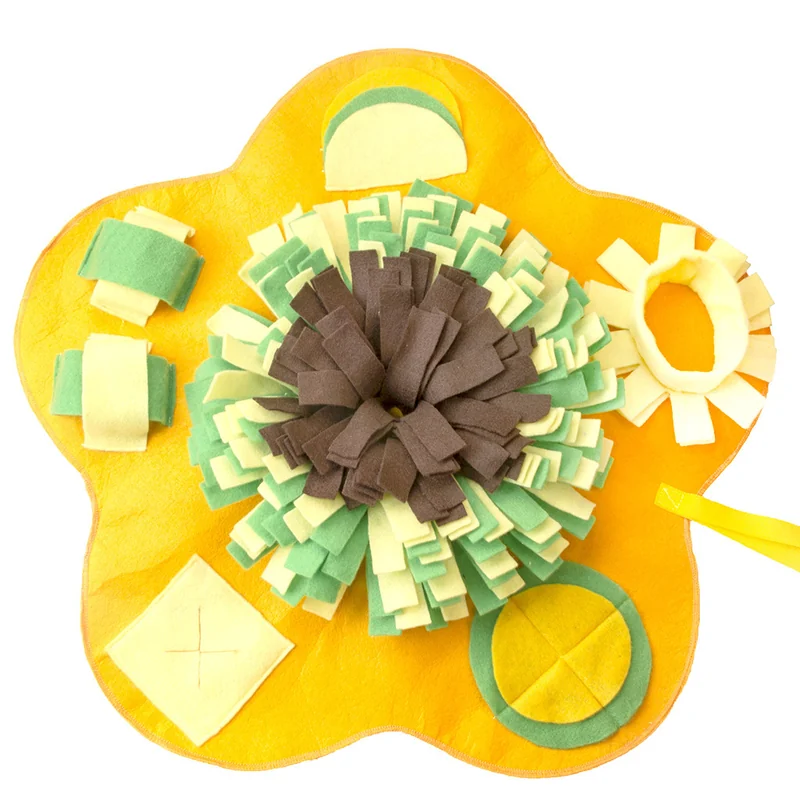
NY-PET-004: Festive Pumpkin Dense-Ruffle Polar Fleece Dog Olfactory Slow-Feeding Pad
420 × 380 × 50 mm · 125 N (28.1 lbf) Radial Petal Lockstitch · Custom OEM Quote
View Full Engineering Specs →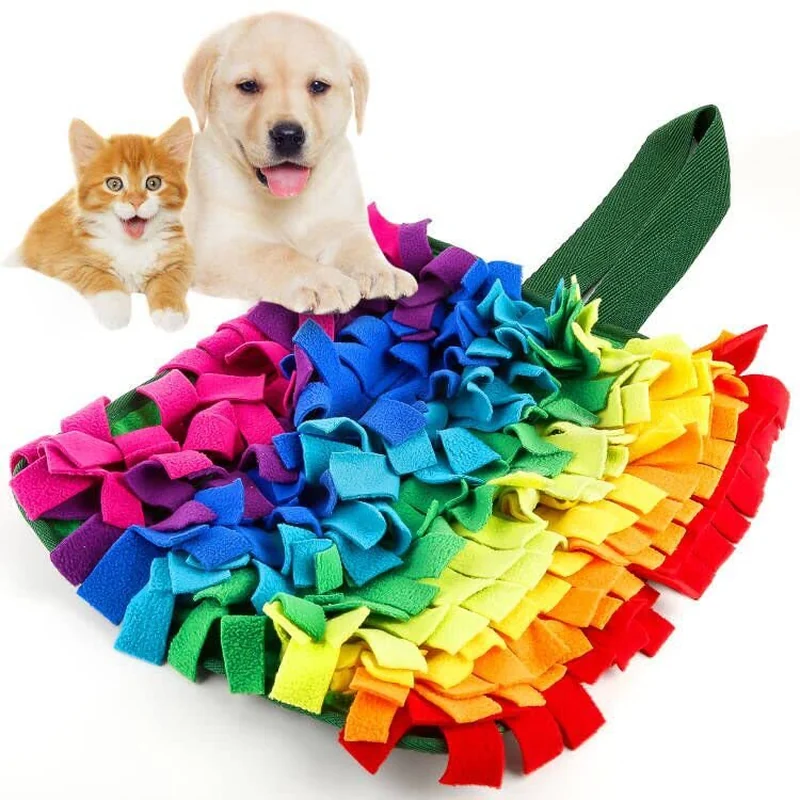
NY-PET-009: Rainbow Goldfish Scale-Pocket Slow-Feeder Snuffle Mat for Medium & Large Dogs
660 × 520 × 42 mm · 130 N (29.2 lbf) Scale Row Lockstitch · Custom OEM Quote
View Full Engineering Specs →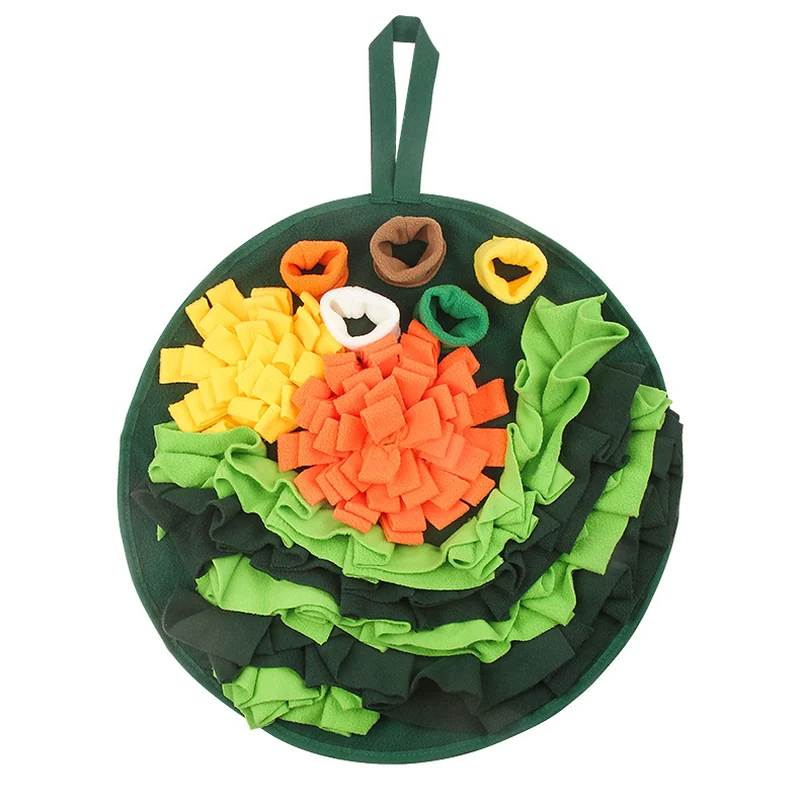
NY-PET-016: Interactive Plush Tissue-Box Pull-Out Crinkle & Treat-Hiding Dog Puzzle Toy
210 × 130 × 95 mm · 128 N (28.8 lbf) Grommet Slot Reinforcement · Custom OEM Quote
View Full Engineering Specs →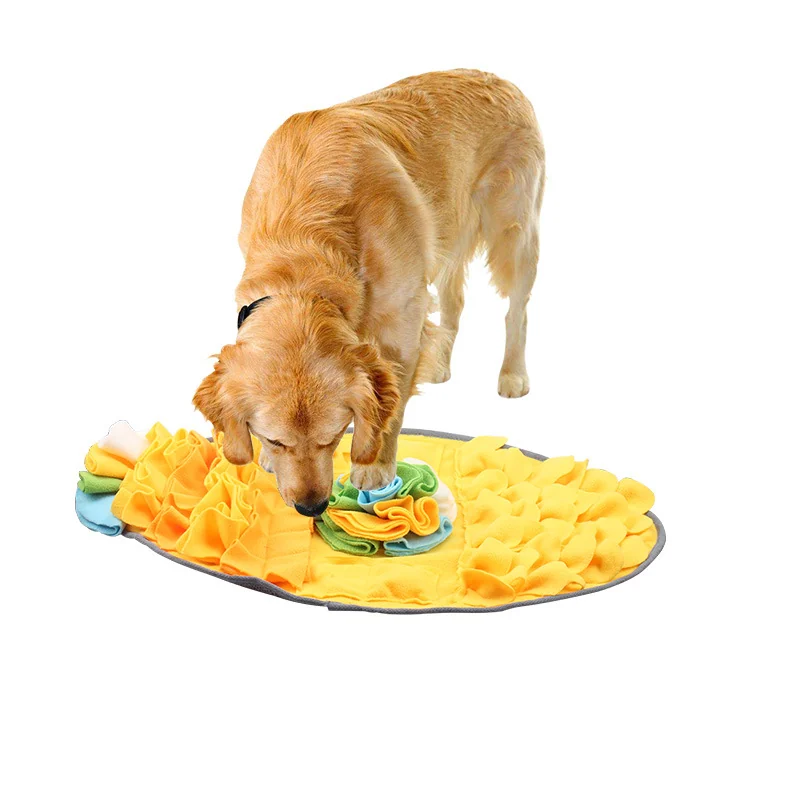
NY-PET-035: Yellow World Crinkle-Sound & Squeaker Patchwork Dog Foraging Activity Mat
720 × 500 × 50 mm · 136 N (30.6 lbf) Multi-Zone Bar-Tack · Custom OEM Quote
View Full Engineering Specs →Explore Companion Engineering Monographs in Our Knowledge Hub
- 320 GSM Anti-Pilling Polar Fleece vs. 160 GSM Felt: Canine Snuffle Mat Textile Engineering Guide (2026-11-10)
- 600D PVC-Dotted Anti-Slip Base & Lockstitch Seam Tensile Engineering for Heavy-Breed Snuffle Mats (2026-11-12)
- Zero-Loop Nail-Safe Stitching & EN71-3 Non-Toxic Dye Standards for Rabbit & Guinea Pig Foraging Mats (2026-11-15)
- 62% Ocean & Amazon FBA Freight Reduction: Vacuum Roll-Compression Rebound Physics for Pet Snuffle Mats (2026-11-18)
- Canine Olfactory Enrichment Biomechanics: Designing Multi-Zone Level 1–4 Snuffle Mats for Pet Brands (2026-11-23)